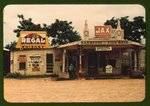
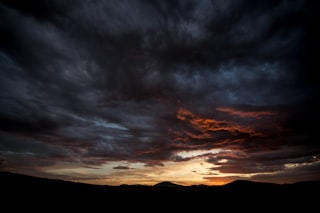
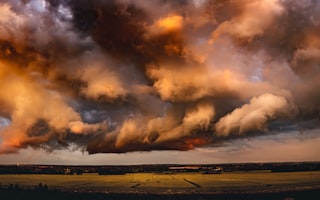
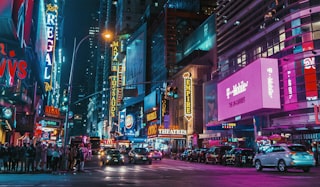
For LensWideOpen Reference CollectionYou've assembled a sequence saturated in mid-century Southern color — the Kodachrome palette doing its slow, almost embalmed work on plantation porches, denuded copper hills, oat fields, and Coca-Cola signs. Let me read what the sequence is doing before I push on it. The opening frame at Melrose, with its stacked signage — Regal, Jax, that hand-lettered storefront — sets a register: vernacular surface, frontal, declarative. You return to that register repeatedly (the tenth frame's live-fish store, the fifteenth's Natchez Coca-Cola wall with the figure leaning in the doorway), and those frontal storefronts become the spine of one thread. A second thread is the scorched copper country around Ducktown and Copperhill — the second, eleventh, fourteenth, eighteenth, and nineteenth frames — and this is where the sequence finally gives me what I want: weather, smokestacks bleeding into a bruised sky, slag-red earth cut by rail line and road, a landscape that has been done violence to and is photographed without flinching. The eleventh frame in particular, with the train threading the dead hills and the smoke plume on the horizon, is the strongest dramatic image you have. A third thread is pastoral — the fourth's boys fishing under the leaning tree, the sixth's anglers reflected in the muddy creek, the ninth and thirteenth's oat harvest, the seventeenth's tenant home under towering cumulus. The seventeenth is the most painterly frame here; those clouds are doing operatic work above a small dark dwelling.
Where the sequence loses me is in the quiet middle. The third and eighth frames — distant houses in landscape — are observational notes rather than photographs that claim their ground. They sit on the page. The twelfth and twentieth, workers in cotton and a field, are documentarily honest but compositionally inert: figures scattered at middle distance, no gesture caught at its peak, no light pressed into service. For a body of work that can summon the apocalyptic palette of Copperhill, these feel like held breath.
Now the push. Your strongest instinct is for landscapes under duress — the copper country frames have storm, scale, and moral weight all at once. Lean harder into that. If you're going to keep the pastoral and the vernacular-storefront threads alongside the industrial-ruin thread, sequence them so they collide rather than alternate politely; put the seventeenth's thunderhead next to the fourteenth's smokestack and let the viewer feel the same sky doing two different kinds of work. The porch portraits — the seventh especially, with the family arrayed across the steps — want a tighter edit; right now the framing is even and the gazes are scattered, and you're leaving the human drama on the table. Get closer, or wait for the moment when the group composes itself into something less posed. The storefront frontals (first, tenth, fifteenth) could become a real typology if you committed — same distance, same light condition, same hour — instead of three loose cousins. And the field-labor frames need either a peak gesture (a hoe at the top of its arc, a back bent against the horizon line) or a radical compositional rethink — low and into the rows, or high and abstract. Right now they're the safe frames in a sequence that is otherwise willing to look at ruined earth. Trust that willingness. The copper hills are your register; let the rest of the work rise to meet them.
STRENGTHS
• The Copperhill and Ducktown frames carry real apocalyptic weight — scorched earth, smokestack, and rail line composed with conviction rather than mere documentation.
• The seventeenth frame's tenant home beneath piled cumulus is genuinely painterly, the kind of sky that earns its melodrama.
• Your vernacular storefronts (first, tenth, fifteenth) have a flattened, sign-saturated frontality that reads as a deliberate visual strategy.
• The Kodachrome palette is handled with restraint — the rust-reds, oat-golds, and bruised purples are allowed to do their own work without being pushed.
• The sixth frame's reflection of anglers in muddy water shows you'll wait for a compositional gift when the landscape offers one.
WHAT TO TRY NEXT
• Sequence the industrial-ruin frames against the pastoral ones directly rather than alternating threads politely — let the smokestack and the thunderhead share a spread.
• Commit fully to the storefront frontals as a typology: lock the distance, the hour, and the light, and shoot twenty of them so the three you have stop reading as cousins and start reading as a series.
• Push closer on the porch and field-labor frames, or wait longer for the peak gesture — the seventh and twelfth are giving up their human drama to middle-distance evenness.
• Cut the observational landscape notes (the third and eighth) unless you can find a version of them with weather, scale, or incident — they're the soft tissue in an otherwise muscular edit.
• Try a low, into-the-rows angle on the field-labor work, or a high abstract one — the eye-level middle-distance framing is the least risky choice you're making.
Read the full review →